

While we argue whether AI can code, some developers went 10x
Public Git history of VS Code and Ghost shows developers whose output grew 5-21x in a year. Agents write 80-95% of their code and leave their signatures in Git.
Pavel Kosyakov, founder of DevGhost · Published
AI writes plausible garbage. Real engineers still write the code themselves.
I hear some version of this every week. Usually from people who either haven’t tried current agents, or who have an interest in keeping expectations low.
Meanwhile, in public Git history, something else is happening. For a few developers the increase was closer to an order of magnitude than to 20-30 percent. It also changed what the job is.
Twenty developers in one
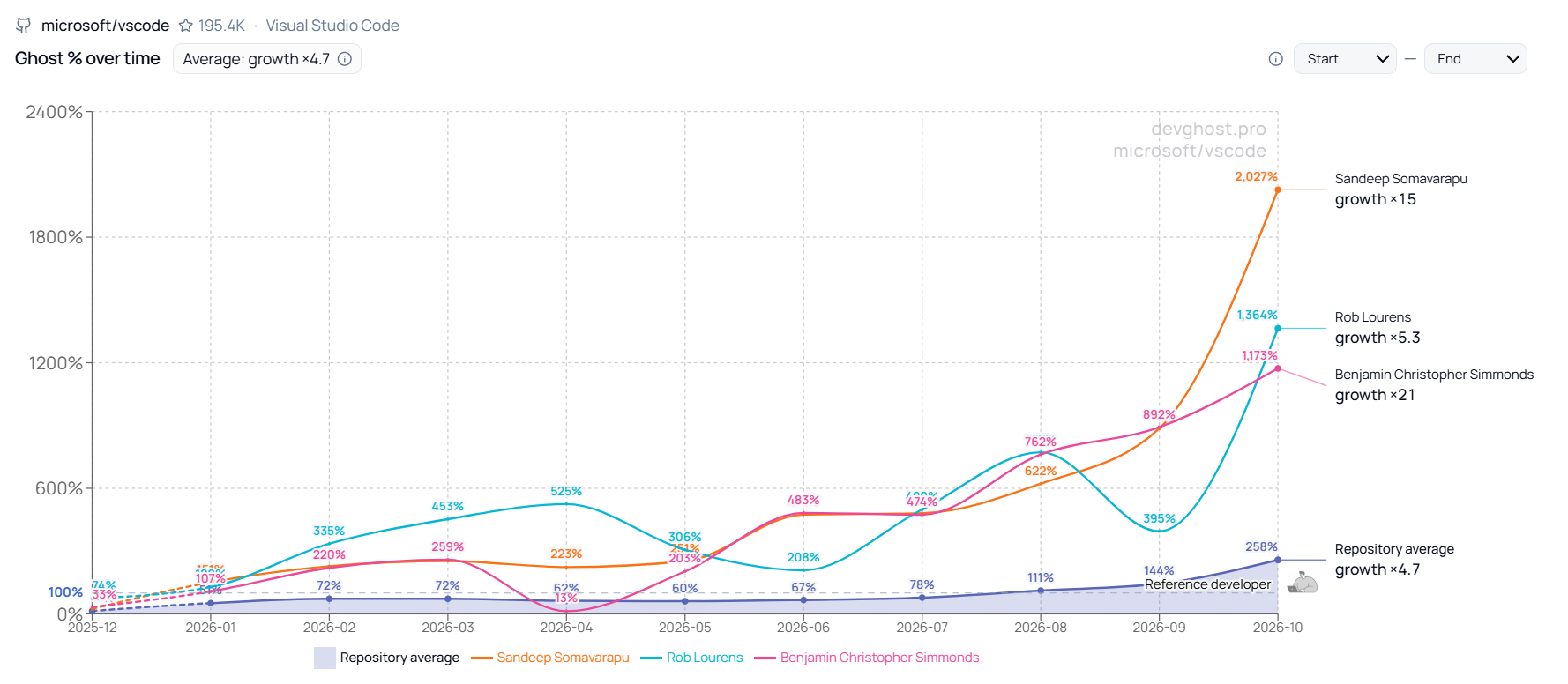
These are three people in microsoft/vscode. Each line is their monthly output compared to a reference: a mid-level developer who knows the codebase and works without AI (the 100% line).
In October 2026 Sandeep Somavarapu was at 2,027%. Rob Lourens at 1,364%. Benjamin Christopher Simmonds at 1,173%. Since December their curves went up 15x, 5.3x and 21x. The repo average is 258%.
To match Sandeep’s October without AI you’d need roughly twenty mid-level people.
Agents sign their work
Full disclosure: the charts are from DevGhost and I’m the founder. So why believe a model’s estimate? You don’t have to. The raw volume is visible on GitHub. Commit counts and lines of code are noisy, but they move the same way. In October 2025 these three landed 178 commits on the main branch. In October 2026 it was 623. How we estimate effort is here.
Who wrote the code is a separate question, and here we didn’t have to guess. Agents leave traces: codex/ and claude/ branch names, Co-authored-by trailers, literal “Written by Copilot” lines, automated replies in review threads.
We looked at every PR the three of them merged between October 1 and November 14, 2026. No keyword filtering. For each PR we checked the original commits before squash, the review threads and the diff.
| Developer | Merged PRs | Own commits with AI attribution | Code written by agents, our estimate |
|---|---|---|---|
| Sandeep | 288 | 1,870 of 1,878 | ~95% |
| Rob | 302 | 563 of 564 | ~95% |
| Benjamin | 184 | 317 of 317 | ~90% |
Sandeep and Rob were each merging about nine PRs a working day, for six weeks.
VS Code can add the Copilot co-author trailer automatically, so we looked for stronger signals. 561 of Rob’s 564 commits end with the literal string “(Written by Copilot)” (example). In 82 of Sandeep’s PRs the review comments are answered with “Automated reply by VS Code Agent Merge”, describing the fix and the tests that now pass (example).
Even the post-review fixes (the part people used to call “the real work”) are done by the agent.
A year ago this was rare. Of those 178 commits in October 2025, only 7 had AI markers.
These people build AI features for VS Code, so they’re early adopters by job description. That doesn’t make them special. It just means they started earlier.
Not just Microsoft
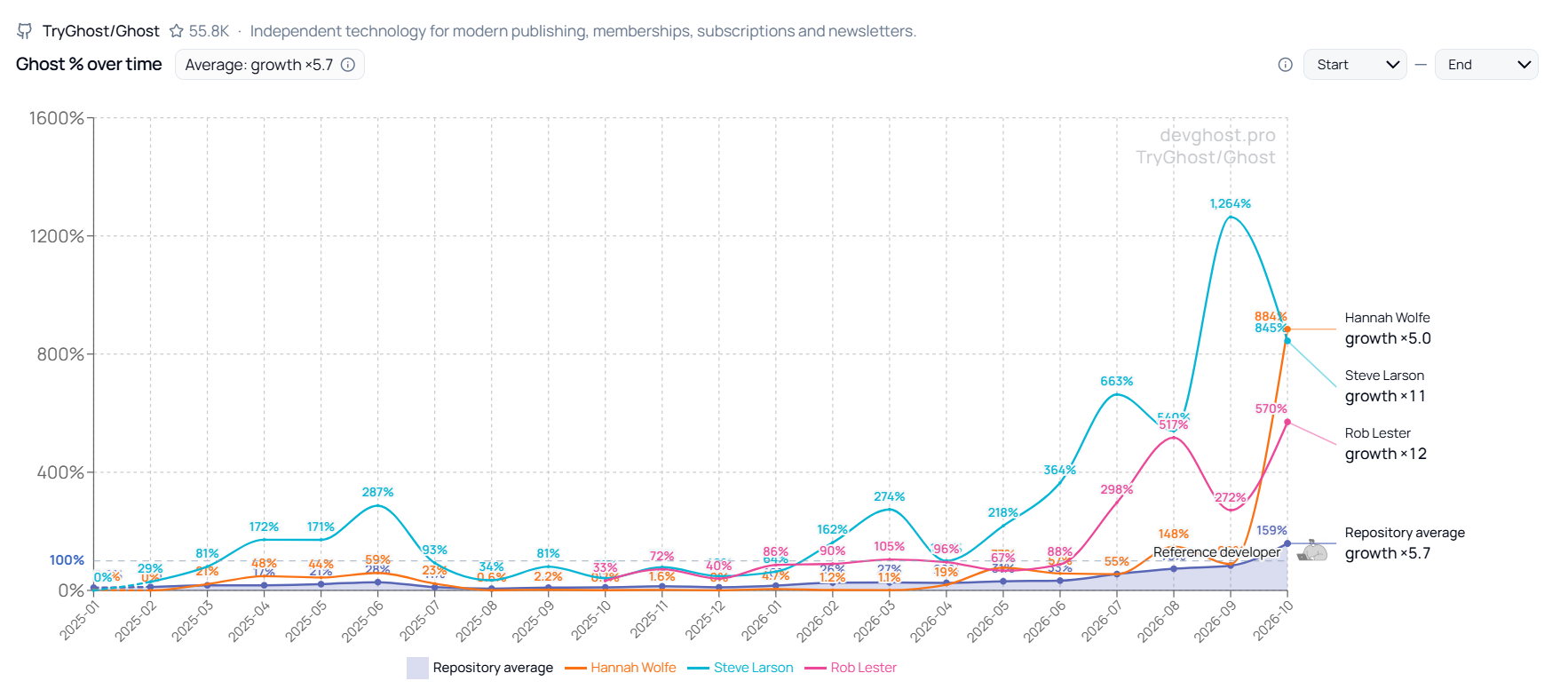
Ghost is an open-source publishing platform run by the non-profit Ghost Foundation. Different kind of place from Microsoft.
When I first saw the Ghost curves I assumed we had a bug in the model. The jump was too clean. So I had an agent go through every one of their PRs.
Hannah Wolfe, Ghost’s co-founder and CTO, merged 180 PRs between October 1 and November 14. 142 of them have direct agent traces: codex/ and claude/ branches, commits authored by Claude, agent-signed fixes. In one of them the agent tightened tests that used to pass without checking the behavior they were supposed to check.
Steve Larson, whose curve grew 11x, merged 317 PRs in October alone. Review fixes on his ordinary branches are signed “Addressed by Claude Code” (example). His own PRs describe the setup behind the pace. One fixes a database collision between parallel Codex worktrees. Another shuts down the dev environment when a Claude or Codex session ends. A third stops subagent environments that kept eating about 1 GB each. One more mentions 15 working copies on one machine, and 48 the day before.
Our estimate: agents write about 85% of Hannah’s code and about 80% of Steve’s.
One person, a small software shop
What these people do now is different. They write the task. Agents write the code and the tests, several at a time. Another agent reviews the result. Hannah added a verifier that never wrote the change and checks it independently, even mutating the code to see whether the tests catch it. One VS Code PR explicitly separates the model that implemented the change from the model that reviewed it. Reviewer comments go back to the agent. The human decides what to build, what is good enough, and what gets merged.
That’s not a faster typist. That’s one person running a small software shop.
In these repositories the question “can AI write production code?” was settled months ago. What comes next is less clear.
The other 90%
Two questions.
Do you already have developers whose output grew 10x? What do they do differently from the rest of the team?
And when this becomes normal in two or three years, and the amount of work doesn’t grow tenfold along with it, what will the other 90% of us do?
The usual answer is the Jevons paradox: cheaper code, more demand for code. I hope so. But demand would have to grow tenfold, and fast.
Data: public GitHub history of microsoft/vscode and TryGhost/Ghost, collected November 14, 2026: merged PRs, original commits before squash, review threads and diffs. Window: October 1 to November 14, 2026, three developers per project. Effort estimates and charts: DevGhost. PR-level evidence is available on request.